Where models contribute
Sonar Pro asks contextual questions. Gemini 2.0 Flash Experimental or GPT-4o turns the answers into a portable prompt.
Experiment 03 / Traigger / 2025–26
A few smart questions turn your rough idea into a sharp AI prompt.
01 / Hypothesis
Moving incomplete instructions between chat and an IDE meant discovering missing requirements through failed code. Could questions catch those gaps before generation?
02 / Smallest loop
Start with a rough goal.
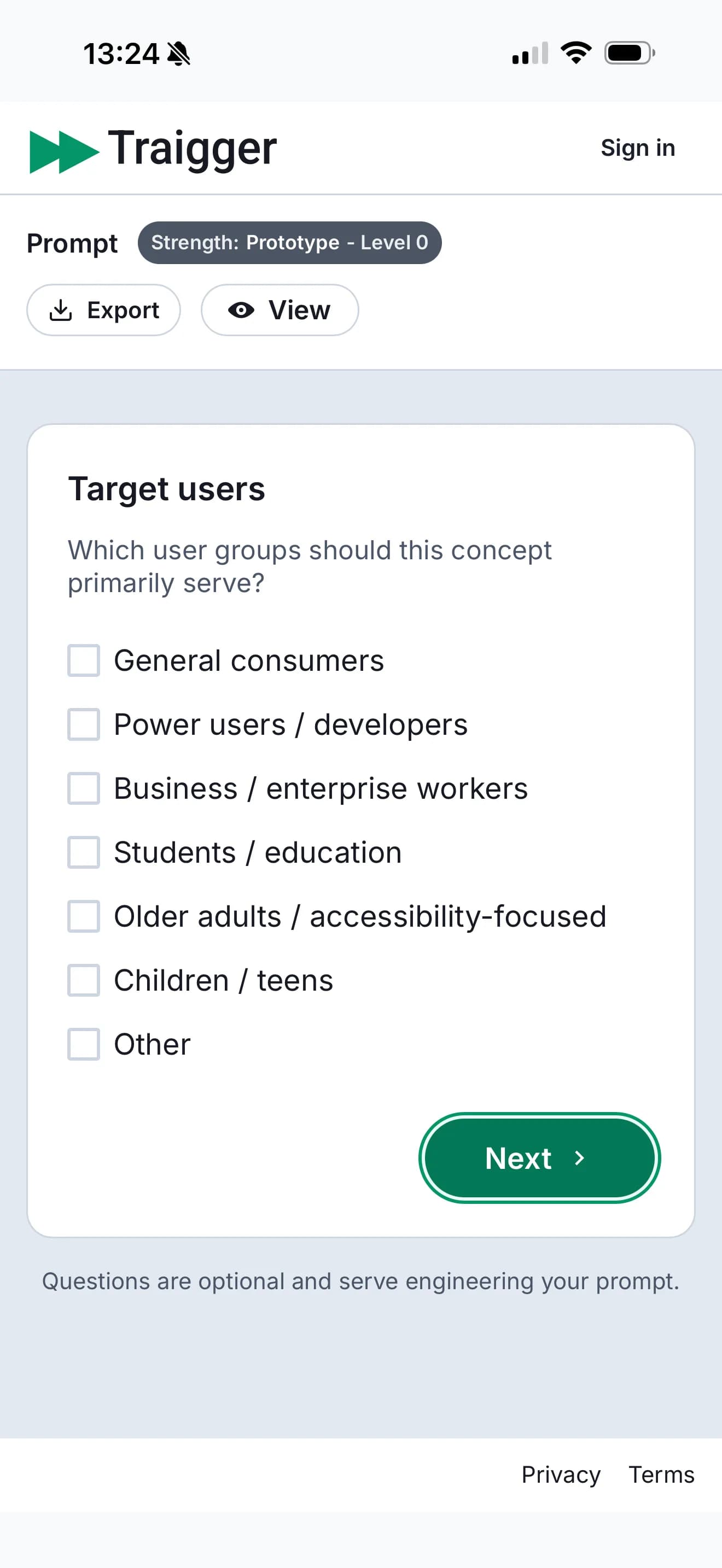
Answer or skip a batch of five questions.
Let answers shape later questions.
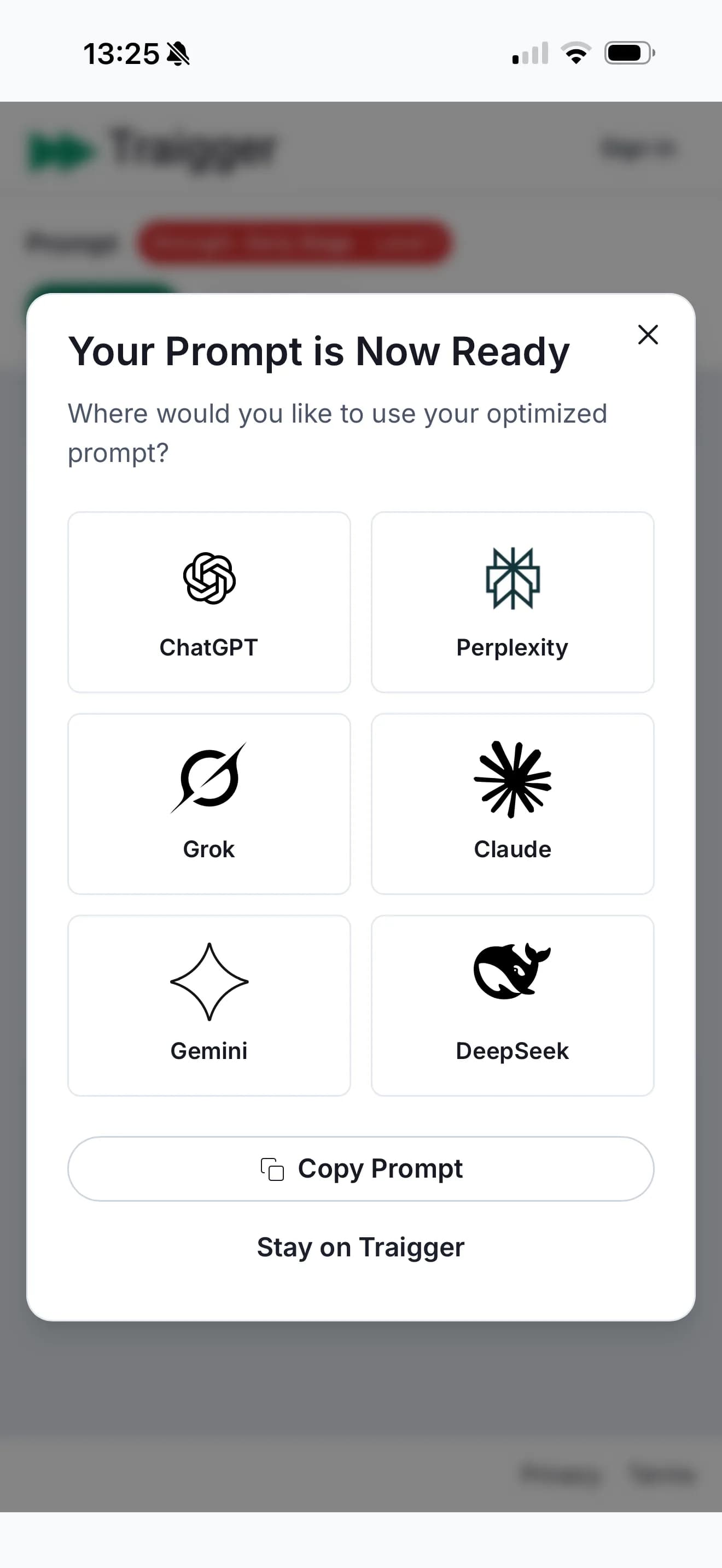
Copy the prompt or open it in a chosen model.
An initial prompt gains detail through increasingly specific, optional questions. A final pass organizes the answers into an optimized prompt, ready for one of six models.
Initial prompt; Questions; Optimization; Model.
03 / Division of labour
Sonar Pro asks contextual questions. Gemini 2.0 Flash Experimental or GPT-4o turns the answers into a portable prompt.
Users own the goal, can skip every question and decide when to export. I designed the questions, provider integration and interface.
04 / Product evidence
Early feedback led to selectable suggestions instead of blank text fields. Prompts can go to six AI destinations.
Reality check / distribution changed the interface
The web app shipped. Native distribution was harder: Google repeatedly reported launch failures; Apple’s latest review required removing the cookie banner. Store requirements became design constraints.
Are contextual questions still useful as AI models improve prompts themselves?